Consumer safety of shellfish is of highest priority, and national and international food safety authorities have implemented maximum allowed levels for prevalent contaminants. An important group are natural toxins, particularly algal toxins. The seawater-filtering shellfish can accumulate certain toxins, which can cause severe incidents of poisoning in consumers.
Algal growth rates and geographical occurrence depend strongly on water temperatures, and rapid changes are observed. Algae can spread to new areas, leading to the presence of so far unknown toxins in these waters. In Norway, the increased occurrence of azaspiracids (AZA), pectenotoxins (PTX), okadaic acid (OA), dinophysis toxins and yessotoxins (YTX) have caused problems for the shellfish industry as well as for consumers.
The effective management of these toxins requires rapid and affordable analytical methods, knowledge about metabolites formed in the shellfish, and information regarding their toxicity. The introduction of risk assessment-based food safety management systems (Hazard analysis and critical control point, HACCP) in the shellfish sector has put focus on the lack of cost-effective tools that would be suitable for in-process testing and verification through end product analysis. The development and validation of rapid assays such as algal toxin-specific ELISA and lateral flow immunoassay kits would solve these purposes. It was therefore a main aim of this project to produce suitable antibodies that were subsequently used in the establishment of relevant test methods.
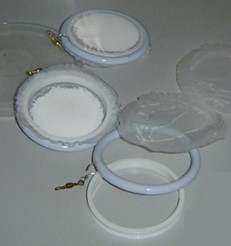
Furthermore, there is a need to introduce early-warning systems for monitoring the presence of algae, plankton and algal toxins in seawater. Toxin-adsorbing disks (TADs) can be used as a simple and sensitive way of monitoring emerging toxic blooms in the water masses. The marine toxins are transferred by passive adsorption onto porous synthetic resin filled disks, and subsequently extracted and analysed by immunoassays (ELISA, LF) or liquid-chromatography mass-spectrometry (LC-MS).
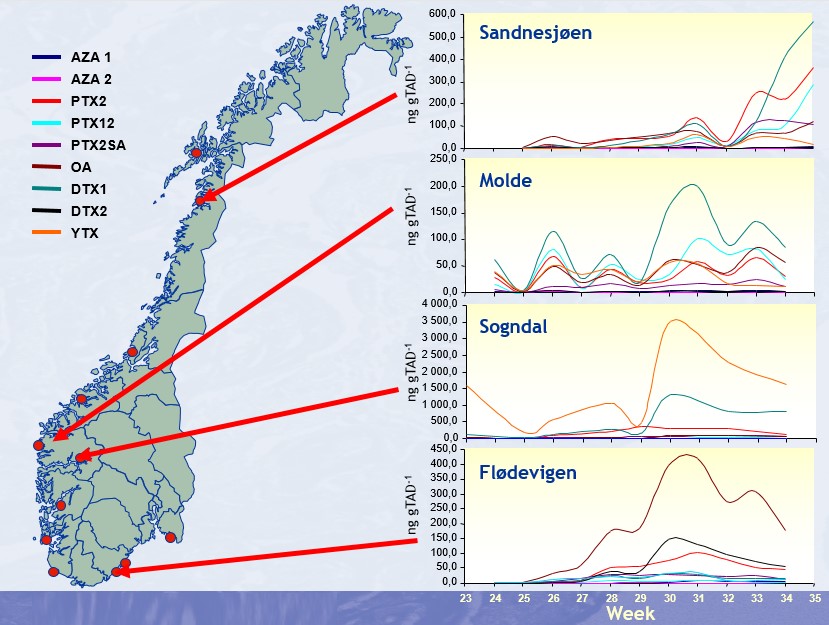
In the project period, TADs were applied in algal toxin monitoring in cooperation with the Norwegian Food Safety Authority in a weekly sampling approach. The results confirmed the increase of waterborne algal toxins during the algal summer bloom along the Norwegian coast.
2008